Caring for Composition Dolls: Cleaning, Storage and What Causes Crazing

What you need
- Soft natural-hair brush (camel hair or similar), clean and dry
- Clean white cotton gloves or freshly washed, dry hands
- Phone or camera for condition photos
- Acid-free, lignin-free archival box large enough for the doll lying flat
- Acid-free tissue, or washed and undyed cotton fabric, for padding
- Optional: polyethylene foam for a cushioned base
- Optional: an inexpensive thermometer-hygrometer to watch the room's humidity
Steps
- Lay the doll on a padded, clean surface in good daylight, away from food and drinks.
- Photograph the face, hands, legs and torso, and write down every crack, flake and repair you see, with the date.
- Look closely, without touching, for paint that is lifting at the edges of cracks; if you find any, stop here and contact a professional conservator or doll restorer.
- If the paint is sound, dust the surface lightly with a dry soft brush, working from the top down and away from loose areas.
- Leave stains, grime and old marks alone rather than reaching for water, cleaners, cold cream or wax.
- Choose a storage or display spot in the main living area of the house, away from the attic, the basement, outside walls, windows, radiators and heat vents.
- Pad an acid-free box with acid-free tissue or washed cotton so the doll cannot slide.
- Lay a sleep-eye doll face down in the box so its eyes rest open.
- Close the box, label it, and set it on a shelf rather than the floor.
- If the doll is on display, keep it in a closed case or cabinet out of direct sunlight.
- Check the doll and compare it with your photos every few months, and after any spell of very dry or very humid weather.
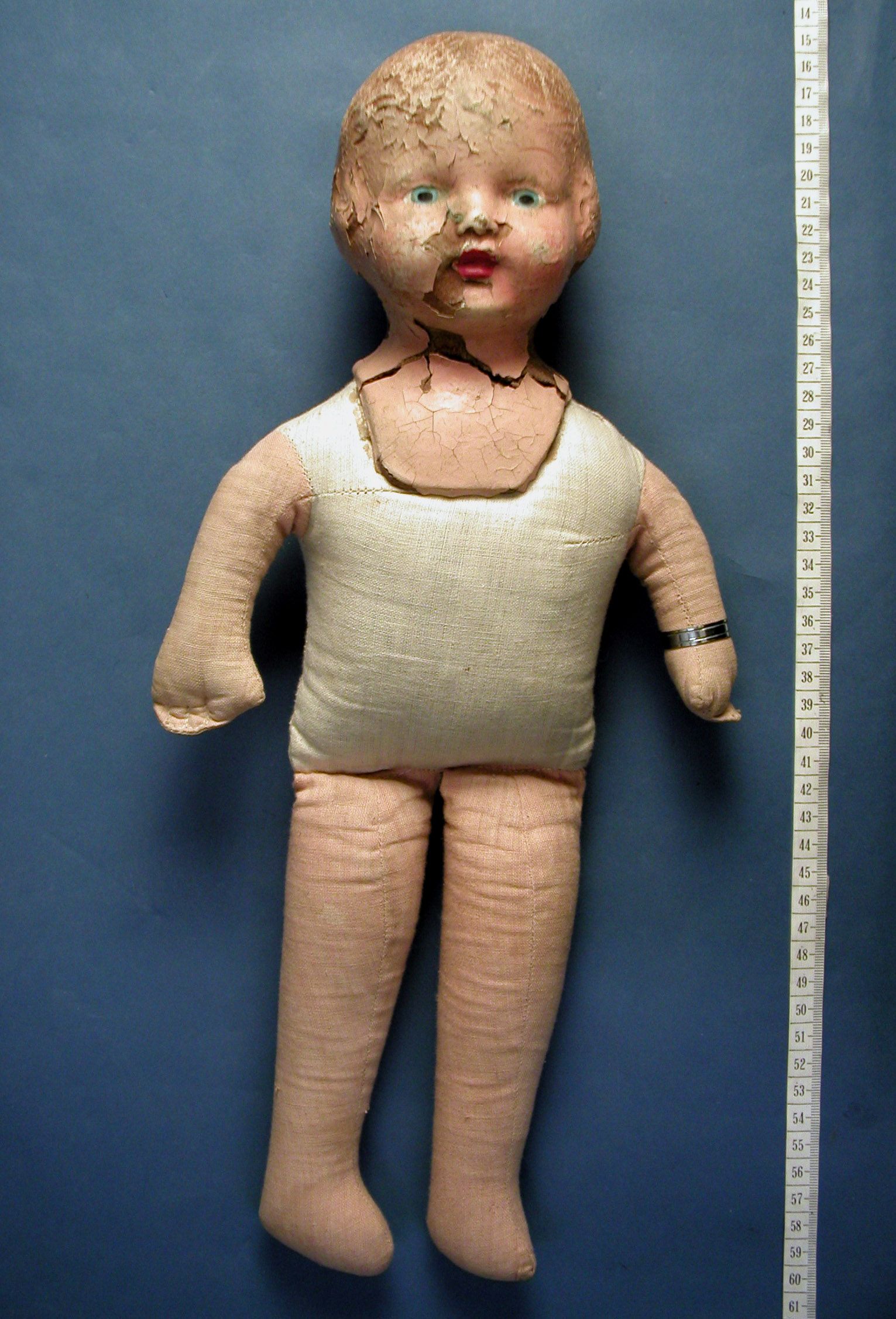
Composition is the material most 1930s Shirley Temple dolls are made of, and it is the main reason so many of them now show fine cracks across the cheeks, arms and legs. Composition was “a composite material composed of sawdust, glue, and other materials such as cornstarch, resin, and wood flour”. Dolls made of it were sold as unbreakable, but over time the material deteriorates, which has left many older dolls with small cracks and flaked surfaces.
The good news is that you can slow that damage without special equipment. The rule followed throughout this guide comes from conservators: keep the doll stable, keep it clean of dust, and leave real repairs to a professional. If you are still working out which doll you have, start with Identify Your Doll and Dolls by Era; this page is about looking after it once you know.
What causes crazing
A composition doll is not one material but several layers. A technical study of 20th-century dolls by conservators at Tate and University College London found a brown, fibrous moulded body containing cellulose and natural resin, a thin layer that may be glue size, and on top a flesh-coloured nitrocellulose paint layer only about 25 micrometres thick on the doll they sampled.
Those layers do not move together. Paul Storch, objects conservator at the Minnesota Historical Society, explains that the inside of these dolls was often made of different materials from the outside, so they react differently to changes in temperature and humidity, and the result is breaks and cracks. Every time the air goes from damp to dry and back, the body and the paint swell and shrink by different amounts, and the thin paint gives way first.
The Tate study shows how far this can go. Its composition dolls with embrittlement had cracking through the moulded material itself as well as in the paint, which the authors read as a sign that composition dolls can become extremely vulnerable over time. Two of those dolls had losses in their feet, probably caused by an old hot-glue mounting method.
Storch also found that composition dolls deteriorate in strangely unpredictable ways. Recipes varied, perhaps daily, even at one factory, so two dolls kept side by side can age very differently. Don’t assume yours is safe because a friend’s doll of the same model has stayed smooth.
Crazing, cracking and flaking
| What you see | What it usually means | What to do |
|---|---|---|
| Fine hairline network in the paint, surface still smooth to the eye | Crazing of the paint layer | Stabilise the environment and keep watching it |
| Cracks with raised or curling edges | Paint starting to lift from the body | Don’t touch or dust that area; ask a professional |
| Loose flakes, or bare brown material showing | Paint loss | Keep any flakes in a labelled envelope; ask a professional |
| Cracks that run into the body, or a soft or crumbling area | The composition itself is failing | Handle as little as possible; ask a professional |
| Cloudy or cracked eye centres | Deteriorating celluloid in the eyes | Leave alone; see below |
On a 1930s Shirley Temple doll, the eyes need their own attention. When The Strong National Museum of Play acquired one, the celluloid centres of its sleep eyes had crazed. The museum’s conservators worked out new treatments, a reversible coating and solvent welding done under a microscope, because their first attempt let a small chip come loose. A home fix is not a sensible place to start.
Cleaning: less is more
The safest cleaning for composition is dry dusting. The National Park Service’s guidance for organic objects calls dusting with a soft brush very effective, but warns that dust is abrasive, that every brushing can remove surface material, and that it can knock off loose pieces. So brush only where the paint is firmly attached, and skip any area with lifting edges.
The same guidance advises against putting cleaners, dressings and waxes on organic objects: they are generally not beneficial and may complicate or prevent later preservation work. Older collector guides often recommend cold cream or petroleum jelly for composition. One such guide suggests Pond’s Cold Cream or Vaseline. A conservator who later has to treat lifting paint may find those residues in the way, so the cautious choice is to leave grime alone.
Storch’s advice is plain: avoid do-it-yourself remedies on dolls that are already cracked, because chemicals and other treatments can do more damage. The goal is to keep the doll from getting worse, not to make it look new.
Storage and display conditions
| Do | Don’t |
|---|---|
| Keep the doll in the main living area of your home | Store it in the attic, basement or garage |
| Use an acid-free, lignin-free archival box | Use an ordinary cardboard box or a plastic bag |
| Pad with acid-free tissue or washed, undyed cotton | Wrap in newspaper or coloured fabric |
| Lay sleep-eye dolls face down | Leave them upright with the eyes shut for years |
| Display in a closed case away from windows | Put it in a sunny window or under hot lights |
| Keep it away from radiators, vents and fireplaces | Sit it on a mantel or above a heater |
| Aim for steady, moderate humidity | Let the room swing from damp summers to dry, heated winters |
Storch’s suggestions for composition dolls are to store them in the main part of the home, use acid-free, lignin-free archival boxes, protect them from dust and direct sunlight on display, and store sleep-eye dolls face down so the eyes are open. He explains that the eyes are held closed by weights, which can damage the dolls’ faces over time.
For humidity, the National Park Service’s commonly recommended goals for organic collections are a relative humidity of 40% to 55%, with less than 5% fluctuation about the set point per 24-hour period and a seasonal change of less than 15%. A home can’t match a museum, but a closed box or cabinet helps a great deal: the NPS notes that an enclosure is of major importance in keeping humidity from fluctuating. The San Diego Natural History Museum gives similar advice for home collections: hallways and rooms without windows are best, no attics or basements, and nothing stored near the heater or fireplace.
Heat matters too. The NPS warns that excessive heat dries out organic objects and can cause irreversible embrittlement, and lists exhibit lighting, direct sunlight, heat registers and radiators as common sources of that heat.
If you need a plastic storage tub, for example to keep out water, a conservator writing for the Association of Manitoba Museums advises looking for PP or PE in the recycling symbol, which shows a stable polymer that will not give off damaging gases. That advice was written for a porcelain doll, but the same conservator’s point applies here: a box acts as a buffer, slowing changes in temperature and humidity. Put the archival box inside the tub rather than the doll on its own.
When to call a professional
Call a professional doll conservator or an experienced composition restorer when:
- paint is lifting, curling or falling off;
- cracks run into the body, or any area feels soft or crumbles;
- the eyes are cloudy, cracked or chipping;
- a limb or the head is loose, or the stringing has failed;
- the doll has been wet, or shows mould;
- the doll is valuable or has important family or studio history.
Storch notes that the means and materials used to stabilise cracking paint on deteriorated dolls are beyond what is available to the non-professional. The NPS likewise recommends leaving chemical cleaning with solvents, detergents and stain removers to a conservator. Ask whoever you hire which materials they will use and whether the treatment can be reversed later, and keep their notes with the doll.
Most collectors accept fine craze lines as part of an old composition doll’s history. Original paint with crazing is still original paint. A doll kept stable at that stage is often a better thing to hand on than one that has been stripped and repainted. If you are weighing up a doll that has already been restored, see Original or Reproduction?.
Common mistakes
- Washing or wiping composition with water or a damp cloth.
- Rubbing in cold cream, petroleum jelly, furniture polish or wax to 'feed' or shine the surface.
- Storing the doll in an attic, basement, garage or closet on an outside wall.
- Displaying it in a sunny window or on a shelf above a radiator or heat vent.
- Gluing down flakes, filling cracks or repainting at home.
- Leaving a sleep-eye doll standing or sitting for years with the eyes closed.
- Moving the doll often between rooms or from storage to display, which exposes it to swings in temperature and humidity.